
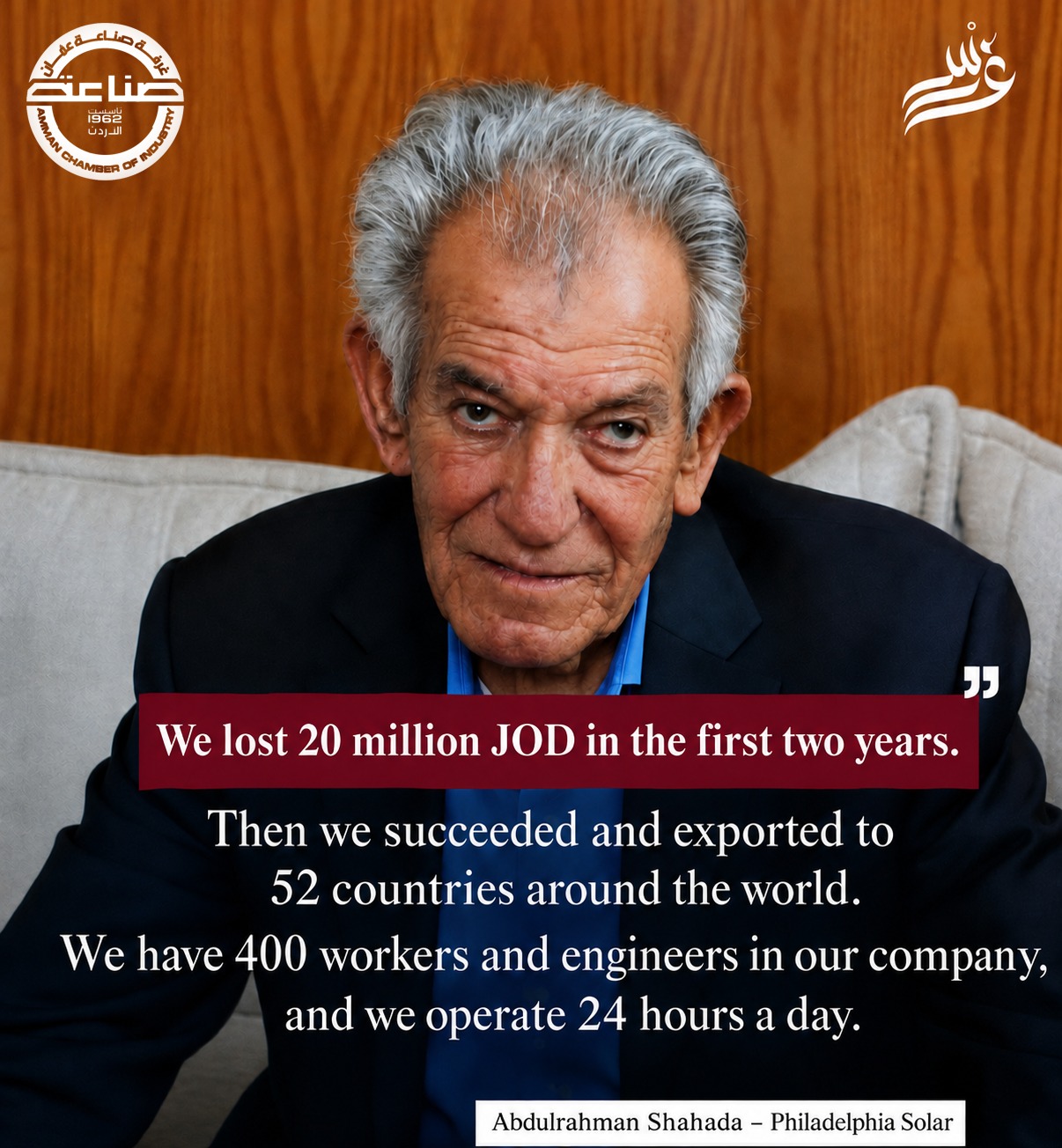
From a Loss of JOD 20 Million to Exporting Across 52 Countries
The story of Abdulrahman Shehadeh and a long-term commitment to building a Jordanian solar industry — a journey that began with major risk and evolved into products reaching markets around the world.
The Beginning
20
Approx. JOD 20 million in losses during the first two years
Global Reach
52
Countries reached by the company's products, as stated in the interview
Scroll
Philadelphia Solar
Abdulrahman Shehadeh
A Jordanian industrial story built on a bold commitment
Not an Overnight Success Story
The real value lies in the distance between loss and global reach.
Jordanian businessman Abdulrahman Shehadeh did not begin his solar-industry journey from a position of guaranteed success. It began with a major risk that cost the project an estimated JOD 20 million during its first two years.
Those losses were not the end of the journey. Investment and development continued until the initiative evolved into a Jordanian industry whose products reach dozens of markets around the world.
 The core commitment from the beginning
01
From Business to Solar Energy
Entering a Sector That Had Not Yet Matured.
Abdulrahman Shehadeh's business experience spans decades, before he moved into renewable energy. When Philadelphia Solar was founded in Jordan in 2007, the local solar market was still in its early stages of development.
The vision was not simply to import and sell solar modules. It was to build industrial capability in Jordan: manufacture the product, develop it, and then compete beyond the local market.
The Hardest Moment
JOD 20 Million.
A figure that could have ended the journey at the start. Instead, it became a real test of long-term investment in an industry that demands capital, technical expertise, certifications, and international markets.
20
Million JOD
Approximate losses during the first two years
02
After the Loss
Instead of Withdrawing, the Investment Continued.
For many ventures, a figure of this size could have been enough to stop. This journey took a different direction: continuing to develop the factory, the product, and technical capabilities instead of abandoning the project.
This stage reveals the essence of the story: major industries cannot always be judged by their first or second year. Building a factory, securing quality certifications, developing a globally competitive product, and establishing an international customer network all require time and sustained investment.
The Transformation Journey
From Foundation to Global Reach.
The Beginning
Building Industrial Capability
Moving from a trading mindset to building a factory and a locally made product.
The Test
Heavy Early Losses
A stage that, by short-term business logic, could have been enough to stop.
The Transformation
Developing Product & Capabilities
Investing in quality, production, and readiness for international markets.
The Result
Exporting to Dozens of Countries
Exports became a core part of the business model.
52
Countries
From the Local Market to the World
When Exporting Becomes Part of the Company's Identity.
As the company grew and its production lines evolved, its markets gradually expanded beyond Jordan until its products reached 52 countries, according to the interview.
Reaching this number of markets means more than selling outside Jordan. It requires compliance with technical standards, international certifications, and the ability to compete with major global manufacturers.
More Than Solar Modules
Building an Industrial Ecosystem Around Renewable Energy.
Solar Module Manufacturing
Developing a Jordanian product capable of entering international markets and competing with global brands.
Steel Structures
Expanding the value chain to include the manufacturing of structures used in solar installations.
Integrated Projects
Designing and executing integrated solar power generation projects.
Energy Storage
Working within modern energy solutions that include battery energy storage systems.
Full Interview
The Journey in Abdulrahman Shehadeh’s Own Words.
In this interview, Abdulrahman Shehadeh reflects on Philadelphia Solar's journey — from the founding years and early challenges to manufacturing expansion and access to global markets.
Watch on YouTube
The Commitment to Jordanian Manufacturing
Trade Sells a Product.
Trade Sells a Product.
Industry Builds Capability.
Philadelphia Solar's story goes beyond the success of one company. It is a model of what Jordanian industry can achieve when it develops technology-driven products capable of reaching international markets.
NEXT
The Next Step
Toward Solar Cell Manufacturing.
The company aims to expand its manufacturing chain further by entering solar cell manufacturing — the core component inside solar modules.
Such a step could increase the local manufacturing share of the final product and give Jordan a more advanced position in the solar-industry value chain.
What Matters Most Is Not the Starting Number or the Final Number, but the Distance Between Them.
Between a JOD 20 million loss in the first two years and reaching dozens of markets worldwide were years of investment, development, risk-taking, and work in an intensely competitive industry.
“A product made in Jordan can compete beyond the Kingdom when it is backed by technology, investment, management, and continuity.
Philadelphia Solar
Contact Our Team